Relieve jaw pain and improve function with OMT
Improve jaw function, ease discomfort and support better posture and breathing with OMT, performed by a qualified therapist.
Our OMT-trained physio targets the root causes of issues, from jaw pain and neck tension to sleep or developmental concerns, with a view to help both adults and children achieve long-term results.
By retraining your muscles and improving facial control, OMT can not only help to relieve symptoms, but can also enhance overall facial function.
What is OMT?
Orofacial myofunctional therapy is targeted at recognising and treating any issues arising from muscles and functions of the mouth, jaw, and neck.
OMT aims to treat not just the symptoms, but also to address the cause of these ongoing issues, including:
- Neck pain/ postural dysfunction
- Jaw pain (temporomandibular joint disorders)
- Sleep disordered breathing
- Developmental problems for children (breathing, chewing/swallowing, facial posture, thumb sucking, tongue tie)
- Facial asymmetry and non-invasive approach to improving facial aesthetics, definition, and reducing facial signs of ageing.
“I have struggled with jaw pain and headaches from teeth grinding and clenching for years. Since starting OMT with Alvin my jaw is more relaxed, my headaches have eased and I’m even sleeping better. He really listens and each session is effective. I can’t recommend him enough.”
– Kate W, OMT physio patient
What does OMT involve?
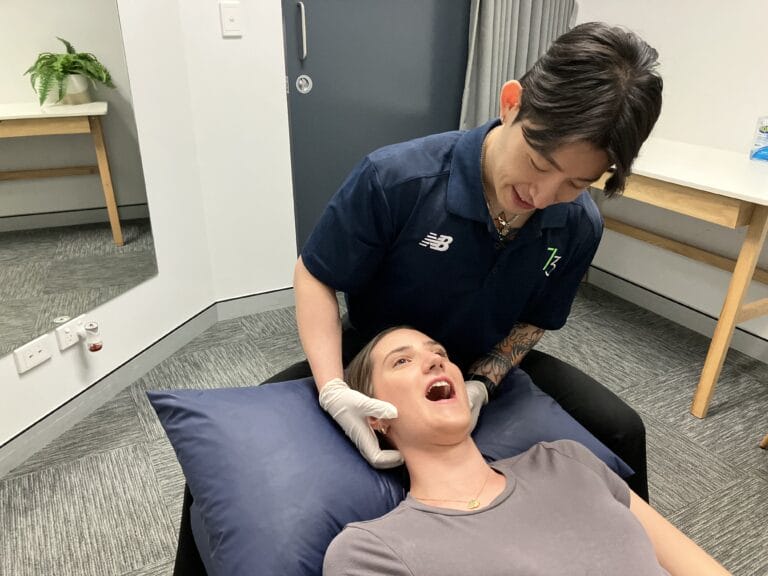
At your OMT session, your physiotherapist will perform an in-depth assessment to identify your specific needs before working on training those muscles to function properly.
Areas of therapy may include:
- Resting tongue posture
- Chewing/ swallowing patterns
- Breathing mechanics
- Strengthening muscles
- Developing better orofacial muscular control
If deemed necessary, your physio can work with other health specialists to ensure that you receive the best treatment. This may include dentists, ENT specialists, respiratory physicians or sleep physicians.
Addressing these issues may seem unremarkable initially but can lead to positive long-term impacts on your health. Especially in children, work done to identify orofacial myofunctional disorders early on can result in better craniofacial development, and potentially see patients avoiding the need for orthodontics later on in life.
Our OMT physiotherapist
Operating from our Leeming physio clinic, Alvin Ho treats a wide range of physical conditions, and has completed additional training in orofacial myofunctional disorders (OMDs). Alvin strongly believes in a holistic approach to long term health and longevity.
Visit the meet our physios page to learn more about Alvin.

Conditions we treat
ATFL (ankle) sprain
An ATFL sprain refers to a sprain of the anterior talofibular ligament – one of the most commonly injured ligaments in the ankle. The anterior talofibular ligament connects the talus bone (in the foot) to the fibula bone (in the lower leg) and helps to stabilise the ankle joint.
An ATFL ankle sprain typically occurs when the ankle is twisted or turned in an unnatural position, causing the ligament to stretch or tear. This can happen during activities such as running, jumping, landing awkwardly or due to a sudden impact or fall.
Baker’s cyst
A Baker’s Cyst (or Popliteal Cyst) is a pocket of fluid that accumulates behind the knee. This can happen due to several different reasons including cartilage tears, arthritis and ligament injuries. The presence of a Baker’s Cyst can cause pain and discomfort in the knee, and treating the underlying cause is necessary to resolve it.
ITB friction
The Iliotibial Band (ITB) is a key piece of structural equipment in the lower body. A thick band running from the outside of your hip to just below the outer knee, it connects the hip to the knee and provides vital stability during activities like walking and running.
When part of the ITB (usually closer to the knee) becomes inflamed and irritated due to sub-optimal loading of the knee joint, it can cause friction between the ITB and the femur.
Lateral hip pain
Lateral hip pain is also known as hip bursitis or greater trochanteric pain syndrome (GTPS). It’s a common condition that is characterised by discomfort or pain on outside of the hip, the area encompassing the greater trochanter (a bony prominence on the femur) and the surrounding soft tissues (including tendons, muscles and bursae.)
Inflammation is one of the main causes of lateral hip pain, or irritation of the trochanteric bursa – a fluid-filled sac that acts as a cushion between the greater trochanter and the overlying muscles and tendons.
Meniscus
The meniscus is a piece of cartilage in the knee joint that serves as a cushion between the thigh bone (femur) and the shin bone (tibia). There are two menisci in each knee, one on the inner (medial) side and one on the outer (lateral) side.
The meniscus is important for several reasons:
- It helps to distribute weight and force evenly across the knee joint, which can help to prevent wear and tear on the joint.
- It provides cushioning and shock absorption for the knee joint during movement, reducing the risk of injury.
- It helps to stabilise the knee joint by preventing the bones from sliding or rotating out of place.
- It helps to lubricate the knee joint, reducing friction between the bones during movement.
- It plays a role in proprioception, which is the ability to sense the position and movement of the body.
Despite a belief that meniscus injuries are most commonly a sporting injury, our physios see and treat this type of knee injury across all groups. Certainly, there are many athletes, particularly those who play sports with a lot of pivoting, twisting or sudden directional changes (such as tennis, basketball, football, skiing and soccer). However, we regularly treat adults and older people who experience natural wear and tear that weakens the cartilage in the knee joint.
Patellofemoral pain syndrome
Patellofemoral Pain Syndrome (PFPS) is a condition that causes pain around the kneecap (patella). It’s a common knee issue that occurs when the patella rubs against the thigh bone (femur), causing irritation and inflammation.
Patellofemoral Pain Syndrome can occur due to various reasons like overuse, muscle imbalance, injury or misalignment of the patella.
ATFL (ankle) sprain
An ATFL sprain refers to a sprain of the anterior talofibular ligament – one of the most commonly injured ligaments in the ankle. The anterior talofibular ligament connects the talus bone (in the foot) to the fibula bone (in the lower leg) and helps to stabilise the ankle joint.
An ATFL ankle sprain typically occurs when the ankle is twisted or turned in an unnatural position, causing the ligament to stretch or tear. This can happen during activities such as running, jumping, landing awkwardly or due to a sudden impact or fall.
Baker’s cyst
A Baker’s Cyst (or Popliteal Cyst) is a pocket of fluid that accumulates behind the knee. This can happen due to several different reasons including cartilage tears, arthritis and ligament injuries. The presence of a Baker’s Cyst can cause pain and discomfort in the knee, and treating the underlying cause is necessary to resolve it.
ITB friction
The Iliotibial Band (ITB) is a key piece of structural equipment in the lower body. A thick band running from the outside of your hip to just below the outer knee, it connects the hip to the knee and provides vital stability during activities like walking and running.
When part of the ITB (usually closer to the knee) becomes inflamed and irritated due to sub-optimal loading of the knee joint, it can cause friction between the ITB and the femur.
Lateral hip pain
Lateral hip pain is also known as hip bursitis or greater trochanteric pain syndrome (GTPS). It’s a common condition that is characterised by discomfort or pain on outside of the hip, the area encompassing the greater trochanter (a bony prominence on the femur) and the surrounding soft tissues (including tendons, muscles and bursae.)
Inflammation is one of the main causes of lateral hip pain, or irritation of the trochanteric bursa – a fluid-filled sac that acts as a cushion between the greater trochanter and the overlying muscles and tendons.
Meniscus
The meniscus is a piece of cartilage in the knee joint that serves as a cushion between the thigh bone (femur) and the shin bone (tibia). There are two menisci in each knee, one on the inner (medial) side and one on the outer (lateral) side.
The meniscus is important for several reasons:
- It helps to distribute weight and force evenly across the knee joint, which can help to prevent wear and tear on the joint.
- It provides cushioning and shock absorption for the knee joint during movement, reducing the risk of injury.
- It helps to stabilise the knee joint by preventing the bones from sliding or rotating out of place.
- It helps to lubricate the knee joint, reducing friction between the bones during movement.
- It plays a role in proprioception, which is the ability to sense the position and movement of the body.
Despite a belief that meniscus injuries are most commonly a sporting injury, our physios see and treat this type of knee injury across all groups. Certainly, there are many athletes, particularly those who play sports with a lot of pivoting, twisting or sudden directional changes (such as tennis, basketball, football, skiing and soccer). However, we regularly treat adults and older people who experience natural wear and tear that weakens the cartilage in the knee joint.
Patellofemoral pain syndrome
Patellofemoral Pain Syndrome (PFPS) is a condition that causes pain around the kneecap (patella). It’s a common knee issue that occurs when the patella rubs against the thigh bone (femur), causing irritation and inflammation.
Patellofemoral Pain Syndrome can occur due to various reasons like overuse, muscle imbalance, injury or misalignment of the patella.
Latest from the blog
Practical physio advice and information to help you build resilience, prevent setbacks and stay active.